 Just read this work and am appalled by it. In my opinion this is the worst of Ishiguro's work. It may be aesthetically well-written but I think it is ethically flawed primarily because it trivializes the massacre of the Chinese by the Japanese during WWII. The protagonist in his search for his mother is seemingly deluded and delusional in that his obsession causes him to ignore the reality of what is going on around him. Some could argue that this is part of Ishiguro's aesthetics, that he is not concerned about representing history but is instead exploring the instability of subjectivity which in part may reference the art for art sake's argument i.e. the work of art should be appreciated for itself not for some moral or transcendental message believed to be inherent in it. The question here concerns the ethics and responsibility of writers in adequately representing global trauma, global holocaust and global massacres without trivializing them. This is particularly so given that the book is written for western readers who may be less aware of the asian holocaust. By glossing over this event which is superficially mentioned in the background of the text, the author is complicit in the larger, political trivializing of this in the imagination of the west.
Saturday, November 5, 2011
When we were orphans
Just read this work and am appalled by it. In my opinion this is the worst of Ishiguro's work. It may be aesthetically well-written but I think it is ethically flawed primarily because it trivializes the massacre of the Chinese by the Japanese during WWII. The protagonist in his search for his mother is seemingly deluded and delusional in that his obsession causes him to ignore the reality of what is going on around him. Some could argue that this is part of Ishiguro's aesthetics, that he is not concerned about representing history but is instead exploring the instability of subjectivity which in part may reference the art for art sake's argument i.e. the work of art should be appreciated for itself not for some moral or transcendental message believed to be inherent in it. The question here concerns the ethics and responsibility of writers in adequately representing global trauma, global holocaust and global massacres without trivializing them. This is particularly so given that the book is written for western readers who may be less aware of the asian holocaust. By glossing over this event which is superficially mentioned in the background of the text, the author is complicit in the larger, political trivializing of this in the imagination of the west.

Monday, September 19, 2011
The thousand autumns of Jacob de Zoet
 I'm not really a fan of historical fiction but recently had to read this book for a class. It's entitled "The thousand autumns of Jacob de Zoet" by David Mitchell and it's absolutely fascinating. Aside from all the intrigue and charges of over-romanticizing oriental culture, Mitchell deftly depicts in stunning clarity the extraterritorial transnational spaces that existed in the seventeenth century. These were essentially trading posts on artificial islands on colonized lands such as Java and governed by companies such as the Dutch East India Company. The text depicts this in-between space where the sovereignty of the nation state and state laws become ambiguous and fuzzy.
Monday, August 8, 2011
The Spectator
 Today I'm pouring over articles published in eighteenth century peridoicals of Addison and Steele's Tatler and Spectator as well as Jonson's Idler. The periodicals mark literature's entry into the public sphere as so well argued by Habermas. Essentially, they established the foundations for literary education later in the late nineteenth century. What's particularly interesting to me is the obvious tensions between anicient and modern; critical reading and critical writing; the notion of taste and the notion of the popular. The function of the critic and the criticism's essential ties to public literary engagements become obvious at this point.
Thursday, August 4, 2011
18th century German Aesthetics

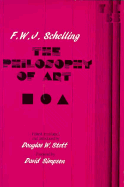 I spent the past week reading through five core classic German philosophers in aesthetics beginning with Baumgarten, and proceeding to Kant, Schiller, Scheling and Hegel. Baumgarten, credited for first coining the term aesthetics as the philosophical study of sensual perception, paved the way for aesthetics as a discipline. It was Kant, however who, in his 1790 publication of Critique of Judgment, established aesthetics as a philosophical discipline moving it away from aesthetics as the study of formal properties of art works instead emphasizing the ontological characteristics of art work through its relation to cognition, beauty, morality and the transcendental Absolute. Someone once told me that among all
 his three critiques, his last one i.e. the Critique of Judgment, was the least important. Yet, on reading Schiller, Hegel and various other secondary readings, I cannot help but see how absolutely influential Kant's ideas are. Almost every philosopher of aesthetics after Kant theorizes aesthetics based on one or another of Kant's claims or assumptions. One may ask what all this has to do with literature education today. In fact, I think Kant's critique is one of the first philosophical writings on aesthetics that is based on the significance of collective aesthetic judgment in the public sphere or what he terms "subjective universality". This subsequently paved the way for further theorizing on aesthetic and literature education. Another interesting point I found is that all five of these scholars situate their philosophy of aesthetics against scientific utilitarianism of their period. For example, Schiller states, "Utility is the great idol of the time, to which all powers do homage and all subjects are subservient". Much like today, they were reacting against the pragmatic-instrumental impulses of the time and in doing so, were fervently attempting to re-establish aesthetics as a core discipline.
Tuesday, July 26, 2011
Arcadia
 Watched this play on Broadway a couple of weeks ago and then bought the play script to read. I must admit, it's been a long while since I watched a play that left me thinking for a long time. An aside here - I think the play might be better read than watched! What is brilliant about the play is that it seemingly leads you in one direction so that at the beginning, you follow along an investigative path; as you come to the end of Act one however, the play's philosophical interest comes to the forefront. It is encapsulated in the question asked right at the beginning "do you think God is a Newtonian" and the merger of investigation and philosophical debates, sexual love and mathematics, past and present all leads to the very powerful climax and the very problem of sponaneity that confounds determinism.
On the aesthetic education of man

I'm using this blog mainly to keep track of my own reading. I'm reading a couple of different things a day. I might read half a book, put it down and read a chapter of something completely different like a play script, move on to a chapter of something else and then return to the book. The trick is how to put all these things in conversation with each other?
Last few days however, I found myself drawn to the German Aesthetic tradition particularly during the period of 1790s when Kant wrote "Critique of Aesthetic Judgement". I started with Baumgarten who was the first to coin the word "Aesthetic" but referred primarily to the study of the sensuous. Then I went on to Schiller's "On the aesthetic education of man" - yes critics have said it is a problematic book because Schiller is not consistent with the technical terms he uses but it is enlightening how a lot of what he says resonates today. For example, the de-valuing of the arts at the expense of science, the privileging of rationality and reason at the expense of sense and feeling, the focus on time/finite at the expense of the infinite and that which is transcedental, beyond time. What I find most interesting is that unlike some contemporary scholars who call for a de-privileging within the space of this dichotomy, Schiller is calling for a third space: "But because both conditions remain eternally opposed to one another, they cannot be united in any other way than by being suppressed. Our second business is therefore to make this connection perfect, to carry them out with such purity and perfection that both conditions disappear entirely in a third one, and no trace of separation remains in the whole, otherwise we segregate, but do not unite" (location 775). This third space is one that then becoems inclusive of multiple realities, of a kind of hybridity at ease with indeterminacy "beauty, does not consist in the exclusion of certain realities, but the absolute including of all; that is not therefore limitation, but infinitude" (location 790).
Last few days however, I found myself drawn to the German Aesthetic tradition particularly during the period of 1790s when Kant wrote "Critique of Aesthetic Judgement". I started with Baumgarten who was the first to coin the word "Aesthetic" but referred primarily to the study of the sensuous. Then I went on to Schiller's "On the aesthetic education of man" - yes critics have said it is a problematic book because Schiller is not consistent with the technical terms he uses but it is enlightening how a lot of what he says resonates today. For example, the de-valuing of the arts at the expense of science, the privileging of rationality and reason at the expense of sense and feeling, the focus on time/finite at the expense of the infinite and that which is transcedental, beyond time. What I find most interesting is that unlike some contemporary scholars who call for a de-privileging within the space of this dichotomy, Schiller is calling for a third space: "But because both conditions remain eternally opposed to one another, they cannot be united in any other way than by being suppressed. Our second business is therefore to make this connection perfect, to carry them out with such purity and perfection that both conditions disappear entirely in a third one, and no trace of separation remains in the whole, otherwise we segregate, but do not unite" (location 775). This third space is one that then becoems inclusive of multiple realities, of a kind of hybridity at ease with indeterminacy "beauty, does not consist in the exclusion of certain realities, but the absolute including of all; that is not therefore limitation, but infinitude" (location 790).
The management of grief
 Read Bharati Mukherjee short story "The Management of Grief" - a really beautiful and moving transnational story. Mukherjee’s story is an example of transnational literature that complicates simplistic and deterministic accounts of globalization. For example, the context of the story involves the Air India Flight 182 terrorist bombing in 1985. The plane, having left Montreal en route through London to New Delhi, explodes over Ireland killing 329 people including 280 Canadians, 27 British citizens, and 22 Indians. In terms of airspace and casualties, the attack transgress national borders even though its rationale seems highly localized since it concerns Sikh militants disgruntled over the India government’s assault on one of Sikhism’s holiest temple. This is an example of how local politics in so-called periphery nations can affect the lives of those in “core” nations. The preceding investigations of the bombing take place, not in India, but in Canada for the next twenty years. Perhaps this is also Mukherjee’s intention in writing this story – to demonstrate that it is a cross-border issue that intersects with other nations and cultures. Thus, much of her story revolves around the idea of travel. The protagonist, Mrs Bhave, in attempting to reconcile her emotions over the loss of her husband and children, travels from Toronto to Ireland and then to India; while back in Canada, she follows a white social worker, Judith, to visit a Sikh family in an apartment dominated by Indian and West Indian community. Yet, it is this motif of travelling that conveys the sense of fluidity rather than a linear, uni-directional movement from core to periphery. This is most clearly evidenced in the scene when Judith gets Mrs Bhave’s help to persuade the Sikh couple to sign a release form that will enable a trustee to manage the couple’s finances. Though Judith, as a representative of the Canadian provincial government, appears altruistic in her offers to help the elderly couple manage their finances, she is not aware of the political implications of her act. By asking the couple to sign the release forms, they are entrusting the payment of the bills, investment of their money, and income to the state. Despite the real danger of losing all the material possessions they have, including their home, the couple continues to hold on to what they deem more important – their autonomy. This autonomy guarantees the freedom for this couple to hold on to their traditions and not allow a foreign state to intrude or influence their belief system which, in this case, means faith in God for the material rather than faith in the state. If signing the release form is representative of the symbolic act of releasing their sons, then autonomy also allows the couple to resist a Western cultural treatment of death by continuing to maintain the hope that their sons will return. When Mrs Bhave reflects that “in our culture, it is a parent’s duty to hope”, there is already an implicit dichotomy between “our” and “theirs” or us versus them. This dichotomy represents that imaginary border in which the “periphery” refuses to submit or conform to the culture and laws of the “core”.
Subscribe to:
Posts (Atom)